Thursday, 1 September 2016

Plant of the month September 2016

Monarda didyma (Bee balm, Wild bergamot)
Family: Lamiaceae
Origin: N America
Location: Beside pond


A herbaceous perennial native to eastern N America, forming a clump of erect stems up to 1m tall, with aromatic, lance-shaped leaves and showy 2-lipped red or pink flowers 3-4cm in length in dense terminal whorls. The flowers are visited by long-tongued bumblebees - short-tongued bumblebees need to make holes at the base of the flowers to obtain nectar, and these holes may also be used by honeybees. Bee balm was used as a medicinal plant by Native Americans, who recognized its strong antiseptic action, and it is the natural source of the antiseptic thymol, the primary active ingredient in modern commercial mouthwash formulas. The genus is named after Nicolas Monardes, who described the first American flora in 1569.


Monday, 22 August 2016

Meet Harry the long eared bat who visited the Garden last night with his carer. His friend Benjy, a pipistrelle, was released in the Garden after being rescued last October and cared for by a member of the Tayside Bat Group.

About a dozen people joined Clare on the bat walk she organised in the Garden. The Bat Group had brought sonic detectors so we were able to hear the bats as well as see them in the dusk.


Thursday, 4 August 2016

Plant of the month for August
Agave filifera (Thread agave)
Family: Asparagaceae
Origin: Central Mexico
Location: Temperate glasshouse


Agave filifera is a small or medium sized succulent plant that forms stemless rosette up to 3 feet (90 cm) across and up to 2 feet (60 cm) tall. The leaves are dark green to a bronzish-green in color and have very ornamental white bud imprints. The flower stalk is up to 11.5 feet (3,5 m) tall and is densely loaded with yellowish-green to dark purple flowers up to 2 inches (5 cm) long.
The specimen in the glasshouse reaches to the roof and hasn't flowered for ten years.


Monday, 4 July 2016

Plant of the month for July

Rosa moyesii (Moyes rose)
Family: Rosaceae
Origin: China
Accession: 1976
Location: Rose garden


Rosa moyesii is a medium to large vigorous deciduous shrub with an attractive branching habit and leaves with 7-13 leaflets. The single flowers are red or deep pink, 6-7cm across, with prominent yellow central stamens, and appear in June and July. These are followed in autumn by large flagon-shaped bright crimson rose-hips. Regarded as one of the finest species roses, it was discovered by Ernest Wilson in 1903, and named after Reverend James Moyes of the China Inland Mission.


Tuesday, 14 June 2016


Seed Collection - Volunteer opportunity for one or more people:

Looking for someone who would be happy to spend a bit of time collecting seed heads in late summer/ autumn from the Botanic Garden, and a few more leisurely hours extracting the seeds and putting them into labelled packets for sale in the Visitor Centre. The current volunteer is reluctantly handing over after enjoying this task for some years!
It could be an individual, or a team of 2 or more folk to share out the various small tasks involved.  

If you are interested, either individually or with friends, please get in touch with Susan Meek, who would be happy to give further details about what’s involved, at srmeek@blueyonder.co.uk

Wednesday, 8 June 2016

Plant of the month for June
Telopea truncata (Tasmanian Waratah)
Family: Proteaceae
Origin: Tasmania
Accession: 1976
Location: Australia and New Zealand area


The genus Telopea contains five species all confined to the Australian east coast from northern New South Wales to Tasmania. T. truncata is an upright shrub to about 3 metres with deep green narrow oblanceolate leaves up to 10cm long. The blooms occur in a loose cluster of 10-20 individual flowers at the ends of the erect stems and are most commonly red. Telopea is from the Greek telopos, meaning "seen from afar", a reference to the conspicuous flowers.
The Tasmanian Waratah prefers moist acidic soils with good drainage. It has been grown successfully in cooler parts of France, Spain, western Canada and the United Kingdom.

Monday, 16 May 2016

Friends visit to Agrico Wednesday 18th - cancelled

We regret that this visit has had to be cancelled due to the very low number of members interested in going.
Please check the events tab for information on future events.

Monday, 2 May 2016

Plant of the month for May
Magnolia stellate (Star magnolia)
Family: Magnoliaceae
Origin: Japan
Accession: 1971
Location: beside Education Centre


M. stellata is a slow-growing medium-sized deciduous shrub or small tree of broadly rounded habit. It blooms at a young age, with slightly fragrant 7-10 cm white flowers covering the bare plant in early spring before the leaves appear. The oblong leaves open bronze-green, turning to deep green as they mature, and yellow before dropping in autumn. It prefers moist but well-drained neutral to acid soil in full sun or part shade with shelter from cold winds. It is a commonly grown ornamental, and was first introduced to the UK in 1877 or 1878, most likely by Charles Maries, while he was collecting for Veitch Nurseries.

Monday, 4 April 2016

Plant of the Month for April

Leucopogon hookeri (Mountain beard-heath)

Family: Ericaceae
Origin: Australia
Accession: 1981
Location: Australasia


A flowering shrub found in subalpine woodland and shrubland and in alpine heath on damp rocky soils in southeastern Australia, it belongs to the family Ericaceae, in the subfamily Styphelioideae (formerly treated as a separate family of Australian heaths known as Epacridaceae). In addition, Leucopogon hookeri is now known as Acrothamnus hookeri (since 2005).
It has small grey-green leaves on a slow growing shrub to 60 cm, and its tiny white tubular flowers are followed by pink or red berries.

Tuesday, 1 March 2016

Plant of the month for March

Eranthis hyemalis (Winter aconite)


Family: Ranunculaceae
Origin: Eurasia
Accession: 1975
Location: Native plants


Eranthis hyemalis is native to damp woodland habitats in Eurasia. It is a tuberous-rooted herbaceous perennial growing to 15 cm, with yellow, cup-shaped flowers held above a collar of leaf-like bracts, appearing in late winter and early spring. The six sepals are bright yellow and petaloid and the petals are in the form of tubular nectaries, which reward early pollinating insects. It is valued in cultivation as one of the earliest of all flowers to appear. Its life cycle exploits the deciduous woodland canopy, flowering at the time of maximum sunlight reaching the forest floor, then completely dying back to its underground tuber after flowering.

Tuesday, 26 January 2016

FEBRUARY FRIENDS TALK

Sunday 7 February 2016

Professor Michael Tooley, garden designer and author. The Restoration of Gardens of Historic Interest. Education Centre in the Garden at 2pm. Free to members of the Friends; donations welcome from others.

Monday, 4 January 2016

Set for ‘16

This event proved very popular on the day after New Year despite the wet and breezy weather conditions, attracting a wide range of ages and ambitions as can be seen from the photos below. Over 30 attended, walking, jogging or running, and our new record time for 3 laps of the Garden is 14m 25s. The warm drinks and eats following the run in the Education Centre capped off an enjoyable hour.


Sunday, 3 January 2016

PLANT OF THE MONTH JANUARY

Araucaria araucana (Monkey puzzle, Chile pine)

Family: Araucariaceae
Origin: Chile, Argentina

 The monkey puzzle is an evergreen conifer native to Chile and Argentina. It was introduced to England by Archibald Menzies in 1795. Its branches are clothed in sharply pointed, triangular dark green leaves, and mature plants bear cones on the upper branches, usually male and female on separate trees. It has existed for 200 million years, and each tree can live for 1,000 years. Once logged for its fine knot-free timber, it is now listed as 'endangered' on the IUCN’s Global Red List of Conifers.


 Find it in the Americas section of the Garden

Thursday, 31 December 2015

Set for '16 Fun Run

The ‘Set for 16’ Fun Run will take place as advertised at 11am on the 2nd and we do hope you will be able to attend. The weather looks set to be wet and breezy, and we would suggest some waterproofs to keep the elements at bay. The running course is tarmacked. There will be warm, mulled punch (non-alcoholic) in the glasshouse afterwards along with various eats and other refreshments.


Tuesday, 29 December 2015

JANUARY FRIENDS TALK

Sunday 10 January 2016

Andrew and Margaret Lear, from Plants with Purpose and Appletreeman will give a talk on the Carse of Gowrie Orchards in the Education Centre in the Garden at 2pm. Free to members of the Friends; others £2.

Thursday, 10 December 2015

Saturday 2nd January 2016 at 11 am - 1pm

Set for '16 - Free fun run around the paths of the University Botanic Garden to get yourself in shape for the New Year. The event caters for all ages and ambitions, just walk or break the record! Your reward, as well as a good time, will include seasonal refreshments in the glasshouse at the end of the run. We look forward to welcoming you to the Garden where we feel sure you will enjoy running or walking in its lovely tranquil and beautiful space.

The event is weather dependent and up-to-the-minute guidance is available  on this blog.

Monday, 23 November 2015

December Friends' talk 

Sunday 6 December 2015.  

Dr Jonathan Wilkin, Abertay University. Peanuts, from plant to snack food. Delve into the world of peanuts on a journey from farm to fork with a much-loved stable food product. Education Centre in the Garden at 2pm. Free to members of the Friends; others £2.

Friday, 13 November 2015

Mystery Walk in the Dark. This event is now fully booked (see Events tab).

Monday, 9 November 2015

November's Plant of the Month

Cycas rumphii (Queen Sago)
Family: Cycadaceae        
Origin: Malaysia to New Guinea 
Accession: 1974
Location: tropical glasshouse


The Queen Sago plant is a gymnosperm, a species of cycad in the genus Cycas native to Indonesia, New Guinea and Christmas Island. It has a male and female form, ours being female with the visible large seeds in the crown. Although palm-like in appearance, it is not a palm. It is a food plant: the trunk of the cycad contains a starchy pith from which sago can be prepared by drying, grinding and washing. In hard times the toxic seeds can be treated to become edible by pounding, repeated washing, and cooking. Although it is abundant in some areas, it is classified as Near Threatened owing to habitat loss.

Tuesday, 3 November 2015

Autumn in the Garden - blue skies make all the difference!


Saturday, 31 October 2015

Don't forget!

Sunday 1st November 2015 Neil Paterson, Education Officer at the Garden. 
From Sea to Shining Sea: some gardens and green spaces of the United States. 
Education Centre in the Garden at 2 p.m.
Free to members of the Friends; others £2. 

Friday, 2 October 2015

THE GREAT ‘DUNDEE’ CHARITY BAKE OFF

Organised by the Dundee Botanic Garden Endowment Trust.
Where? Doubletree by Hilton
When? Thursday 29th October 2015 from 7-9.30pm
How much? £15

https://sites.dundee.ac.uk/botanicgardentrust/the-great-dundee-halloween-bake-off/


Friday, 18 September 2015


The Events page has been updated - have a look and see the programme of talks from October 2015 to March 2016.

Sunday, 6 September 2015

A successful  day for the Garden at the Dundee Food and Flower Festival as the display created by Bob and his team on the theme of Scottish food and drink won a Silver Medal certificate. Well done all.
Audrey and Margaret on duty  at the stand.

The Silver Medal certificate

Thursday, 3 September 2015

September's plant of the month

Hydrangea arborescens ssp. discolor ‘Sterilis’
Family: Hydrangaceae   Origin: Garden   Accession: 1975
location: by the Rose Garden

Monday, 17 August 2015

Botanic Garden on the Beechgrove Garden!

On 30th July 2015  the Beechgrove Garden  were filming for a full day in the Botanic Garden for a  6 to 8 minute section within the programme.   
The areas covered we believe are:
  • Opening with Jim McColl talking about the Macro Micro Building
  • Evolution Garden – with Neil Patterson & Jim McColl
  • Genetics Garden – with Professor Claire Halpin & Jim McColl
The programme is scheduled to be shown on:
  • Thursday 20th August 2015 on BBC 2 (Scotland) at 7.30pm
  • Sunday 23rd August 2015 on BBC 2 at 09.00am
All very exciting - a "must watch"?

Monday, 3 August 2015

August: Plant of the Month

Cassinia vauvilliersii (Mountain cottonwood)

Family: Asteraceae    Origin: New Zealand   Accession: 2010
find it in amongst the Australasia plants.


Monday, 13 July 2015

The Friends at Barnhill Rock Garden Gala Birthday on Saturday 11 July

Plants disappearing like hot cakes

Elaine's balancing butterflies were very popular

The snails were popular with the children but not so much with the grown-ups

Friday, 10 July 2015

Seen in the garden this month

All you need now is a frog.


Bees enjoying the eryngium in the glasshouse border

Friday, 26 June 2015


We had company in the workplace at the Garden yesterday: part of Dr Chris Connolly's research on the  impact of environmental toxins on insect health - counting bumble bees and measuring the impact of insecticides on the colonies.


Thursday, 11 June 2015

Planting a second row of lavender in the new herb garden in a very  straight line

All laid out and ready to go


Hard at work planting

Watering them in  on a very hot day

Monday, 8 June 2015

The Friends had a stall at WestFest on Sunday 7th June and raised another £112 by selling plants. The gazebo stayed up in spite of the wind!


Thursday, 4 June 2015

New kid on the blocks at the Garden - whatever next!


Next time you are in he may be in his final position, wherever that will be. Meantime, he is near the dry stone walls.

Monday, 18 May 2015

Plant Power day and Friends' plant sale


We'd love to see you at the Plant Power day in the Garden this coming Saturday 23 May,  from 10am till 4pm, to co-incide with the International Fascination of Plants Day http://fascinationofplantsday.org/home.htm

This is also the day of the Friends' annual plant sale, our main fundraiser of the year, so we hope you will come along and buy plants as well as enjoy all the fun things happening in the Garden.

Saturday, 2 May 2015

Plant for May

Larix griffithii (Sikkim Larch)
Family: Pinaceae    Origin: E Himalaya     Accession: 1978


Thursday, 16 April 2015


Lots to look at in the Garden at the moment, and we are busy potting up lots of annuals for summer colour too.

Camellia

Magnolia

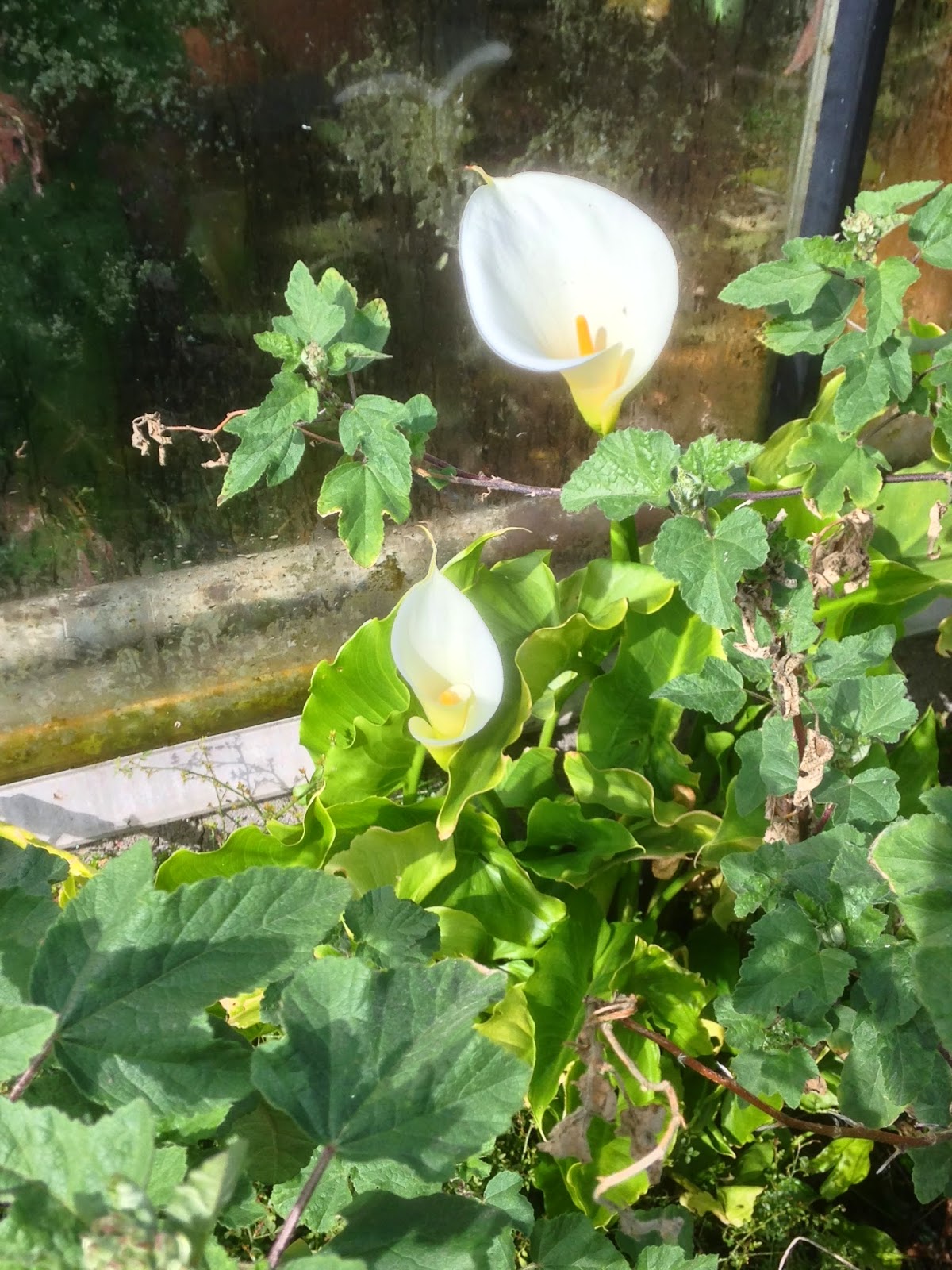
Arum lily 

Wednesday, 1 April 2015

April's Plant of the Month

Ulmus glabra 'Camperdownii'
(Camperdown elm)
Family: Ulmaceae   Origin: Scotland   Accession: 1974
The Camperdown Elm is a natural mutant of Scotland’s native wych elm. It was discovered by chance around 1835 by the Earl of Camperdown’s head forester David Taylor, who transplanted the tree to the grounds of Camperdown House on the outskirts of Dundee where it still survives. Unlike surrounding elms it has not succumbed to Dutch elm disease, perhaps because of its small stature or contorted habit; its bizarre branch structure has been likened to a living sculpture. Its flower buds open in spring, though it cannot reproduce from seed. However it has been widely propagated from cuttings, usually grafted onto wych elms, and many examples were planted in Britain and America, satisfying the Victorian passion for curiosities.

find it among the Americas