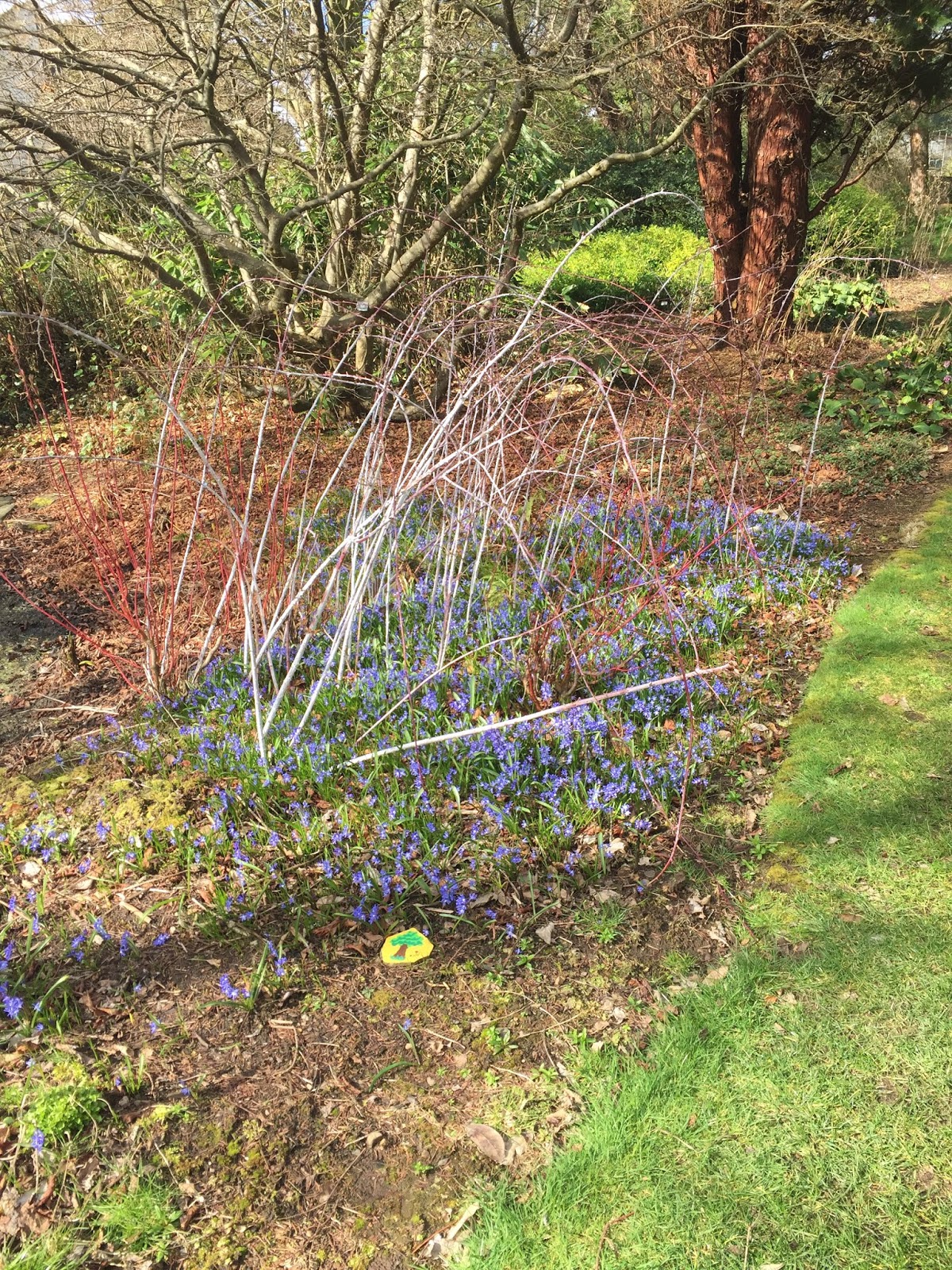
Beautiful new coloured glass features marking the seasons in the Good Grief garden. installed so far are summer and autumn.
The Friends of the University of Dundee Botanic Garden is a charity whose aim is to support and promote the development of the Garden
Wednesday, 26 October 2022
Thursday, 5 May 2022
Thursday, 3 March 2022
Sunday, 8 March 2020
Plant of the Month March 2020
Garrya elliptica
Garrya
elliptica, the coast silk-tassel,
silk tassel bush or wavyleaf silktassel, is a species of flowering plant in the
family Garryaceae, native to the coastal ranges of California and southern
Oregon. It is an erect, bushy, evergreen shrub reaching a height of 2–5 m (7–16
ft). The unique characteristics of Garrya elliptica are its waxy convex leaves
with wavy leaf margins, coupled with dense individual hairs on the leaf
undersides that are scarcely distinguishable with a hand lens. Its leaf blades
are 6–8 cm (2.4–3.1 in) in length, and the petioles range in length
from 6-12 mm.
Sunday, 15 December 2019
New Year Fun Run 2020
Registration for this event has now closed.
On Thursday 2nd
January at 11am and until 1pm there will be a 5k fun run around the paths of
the University Botanic Garden to get yourself in shape for the New Year. The
event caters for all ages and ambitions, just walk or break the record! Your
reward, as well as a good time, will include seasonal refreshments in the education
centre at the end of the run.
As of today (1st Jan) the weather on the 2nd is expected to be cool and largely cloudy, with a fresh wind from the south west.
Best wishes for the festive
season,
The Friends’ Committee.
Thursday, 27 June 2019
Summer holiday rock search!
The holidays are nearly here. Come on down and try our Summer Holiday Rock Search. There are map sheets, clipboards and pencils at Reception. And this time the rocks stay where you find them - no need to re-hide! The theme is birds, bees, and butterflies.
Normal entrance charges to the Garden apply. But we're very sorry no dogs are allowed in the Garden.
Between Mon 1st July and Fri 30th August, Monday to Friday only, the Garden will remain open until 8.30pm.
Friday, 24 May 2019
Monday, 1 April 2019
Plant of the Month April 2019
Family: Hamamelidaceae
Origin: Japan
Location: Asian Plants
Accession: 1975
Corylopsis spicata (Winter hazel)
Family: Hamamelidaceae
Origin: Japan
Location: Asian Plants
Accession: 1975
Corylopsis spicata is
in the Witch Hazel family, a deciduous shrub up to 2m in height and 3m wide,
native to Japan. The racemes of bell-shaped scented pale yellow flowers with
red anthers are borne on bare stems in late winter and early spring. The alternate,
broadly ovate, leaves are bristled with toothed edges, blue-green underneath
and bright-green above. Leaf buds change from dark-red to dark green as the
leaves emerge. It prefers moist, well-drained, acid soil and a sheltered site
with partial shade.
Friday, 22 March 2019
Wednesday, 6 March 2019
Plant of the Month March 2019
Family: Pinaceae
Origin: NE Asia
Location: Beside Native Plants
Accession: 1971
Pinus pumila (Dwarf Siberian Pine)
Family: Pinaceae
Origin: NE Asia
Location: Beside Native Plants
Accession: 1971
Pinus pumila is
a coniferous evergreen shrub ranging from 1–3m in height. The leaves are
needle-like, formed in bundles of five and are 4–6cm long. The cones are
2.5-4.5cm long, with large nut-like seeds. It is a native of north-eastern
Asia, its range including eastern Siberia, north-east Mongolia, north-east
China, northern Japan and Korea. It can be found along mountain chains, where
it forms uninterrupted hard-to-pass thickets, and alongside the Okhotsk and
Bering Seas and Pacific coast. It grows very slowly, especially in harsh
conditions, and can live up to 300 and even 1000 years. It is often grown in
ornamental parks and gardens
Tuesday, 19 February 2019
Plant of the month February 2019
Hedera cypria (Cyprus ivy)
Family: Araliaceae
Origin: Europe
Location: Mediterranean Area
Accession: 1988
An attractive and
vigorous species of ivy, with thick, dark green, triangular leaves marked with
silvery veins, endemic to the island of Cyprus. It grows up to 20m high by
means of aerial adventitious roots or makes a good ground cover. Ivies have
enormous value to wildlife, providing year-round shelter for many
creatures including birds, small mammals and invertebrates. In flower, they
provide an invaluable late source of nectar and pollen for bees and other
pollinators. Ivy fruits are much appreciated by birds in late winter when other food sources
are scarce.
Monday, 7 January 2019
Plant of the Month January 2019
Family: Aloeaceae
Origin: Temperate South Africa
Location: Temperate glasshouse
Accession: 1976
Aloe arborescens (Candelabra aloe)
Family: Aloeaceae
Origin: Temperate South Africa
Location: Temperate glasshouse
Accession: 1976
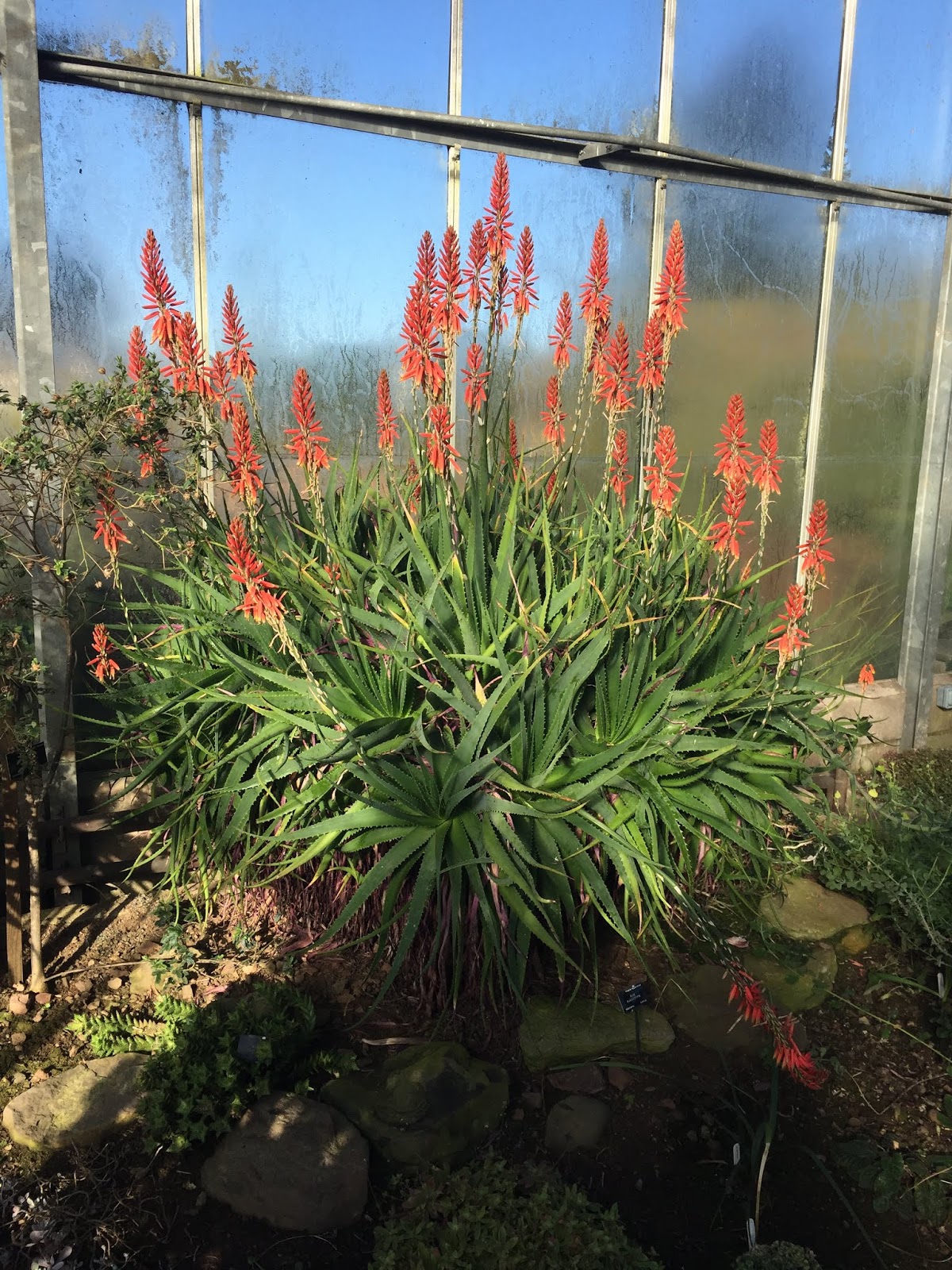
This species of aloe
reaches 2-3m in height, with many rosettes of blue-green fleshy leaves with
soft teeth running along their edges. Tall orange-red racemes of flowers, full
of nectar, rise from the rosettes attracting butterflies, birds and bees in the
cold winter months. It grows on rocky outcrops in its native South Africa and
has been used to fence livestock enclosures. The succulent leaves contain a
pulp that is known to soothe the skin, especially from burning and redness, and
has many other medicinal uses.
Thursday, 3 January 2019
Fun Run 2019
This year's New Year 5k fun run was the largest so far with over 120 attending. The morning was crispy cold and bathed in sunshine. This year's winning time was 17' 51", but for many this was just an opportunity to have an enjoyable walk with friends and family. The run is now a fixture and for the first time we had regular visitors to the Garden while the run was on.
Thursday, 6 December 2018
Plant of the Month December 2018
Family: Musaceae
Origin: Philippines
Location: Tropical Glasshouse
Accession: 1977
Musa textilis (Manila hemp, Abacá)
Family: Musaceae
Origin: Philippines
Location: Tropical Glasshouse
Accession: 1977
Musa textilis is a species
of banana native to the Philippines, grown as a commercial
crop in the Philippines and in Central America for its fibre known as Manila
hemp, which is extracted from the leaf sheaths. During the 19th
century, alongside sugar and tobacco, it was one of the main cash crops of the
Philippines, which still produces 85% of world output. As the strongest of all
natural fibres, it was once used primarily for rope, but is now mainly used for
specialized papers such as tea bags, banknotes and decorative papers. The
fruit is inedible due to its many black cone-shaped seeds.
Monday, 5 November 2018
Plant of the Month November 2018
Family: Scrophulariaceae
Origin: South Africa
Location: South Glasshouse border
Accession: 2018
Buddleja auriculata (Weeping
sage)
Family: Scrophulariaceae
Origin: South Africa
Location: South Glasshouse border
Accession: 2018
B. auriculata is an evergreen shrub to 3m, with lance-shaped, dark green leaves,
white beneath, and small orange-centred, white flowers in dense panicles in
autumn and winter. The flowers are strongly fragrant with a scent which has
been compared to Chanel No. 5. It is not hardy below -10 °C, so best
grown against a south-facing wall. In the UK, the shrub is often planted
as a source of nectar for late butterflies and bees.
Thanks to Maggie Gowland for photographs.
Tuesday, 2 October 2018
Plant of the month October 2018
Coprosma rugosa
Family: Rubiaceae
Origin: New Zealand
Location: Australia/New Zealand
Accession: 2012
Coprosma rugosa, also known as the needle-leaved mountain coprosma, is a stiff erect evergreen shrub up to 3m tall. It has many interlacing wide-angled twigs bearing clusters of pairs of very narrow leaves. It forms extensive thickets in grasslands and forest margins in lowland to subalpine areas on moraines and river terraces. It has inconspicuous flowers followed by abundant small pale blue berries in autumn, the seed of which is widely dispersed by birds. It is dioecious (individual flowers are either male or female, but only one sex is to be found on any one plant so both male and female plants must be grown if seed is required) and is wind-pollinated. It is very hardy and suitable for hedging.
Thanks to Maggie Gowland for photographs.
Coprosma rugosa
Family: Rubiaceae
Origin: New Zealand
Location: Australia/New Zealand
Accession: 2012
Coprosma rugosa, also known as the needle-leaved mountain coprosma, is a stiff erect evergreen shrub up to 3m tall. It has many interlacing wide-angled twigs bearing clusters of pairs of very narrow leaves. It forms extensive thickets in grasslands and forest margins in lowland to subalpine areas on moraines and river terraces. It has inconspicuous flowers followed by abundant small pale blue berries in autumn, the seed of which is widely dispersed by birds. It is dioecious (individual flowers are either male or female, but only one sex is to be found on any one plant so both male and female plants must be grown if seed is required) and is wind-pollinated. It is very hardy and suitable for hedging.
Thanks to Maggie Gowland for photographs.
Tuesday, 4 September 2018
Plant of the month September 2018
Heliconia bihai
Family: Heliconiaceae
Origin: Central & South America
Location: Tropical glasshouse
Accession: 1982
Heliconia bihai
Family: Heliconiaceae
Origin: Central & South America
Location: Tropical glasshouse
Accession: 1982
Heliconia bihai is an erect herbaceous
plant up to 5m tall with leaf blades to 60cm, native to northern South America
and the West Indies. It is typically pollinated by bats and hummingbirds. Its flower
is an inflorescence with 7-12 upward-facing bright red bracts which hold
rainwater used by birds and insects.
Thanks to Maggie Gowland for photographs
Tuesday, 7 August 2018
Thursday, 2 August 2018
Plant of the Month August 2018
Solanum laciniatum (Poroporo, Kangaroo Apple)
Location: Australia/New Zealand
Accession: 2012
Solanum laciniatum (Poroporo, Kangaroo Apple)
Family: Solanaceae
Origin: New Zealand, SE AustraliaLocation: Australia/New Zealand
Accession: 2012
S. laciniatum is a large evergreen
shrub to 3m or more, with pinnately-lobed juvenile leaves 30cm long and smaller
lance-shaped adult leaves 15cm long. Its light purplish-blue flowers, 5cm wide,
with broadly triangular petals, are followed by egg-shaped bright
orange-yellow berries, 2-3cm long. All green parts of the plant and the
unripe fruit are toxic; the young foliage contains a series of steroids which
are of commercial value as raw material for the manufacture of contraceptives.
It is not fully hardy, and is short-lived even with frost protection, but is
easily propagated from seed.
Thanks to Maggie Gowland for photographs.
Monday, 9 July 2018
Plant of the Month July 2018
Cardiocrinum giganteum (Giant Himalayan Lily)
Family: Liliaceae
Origin: Himalaya, China
Location: Asian Plants
Accession: 1979
Cardiocrinum giganteum (Giant Himalayan Lily)
Family: Liliaceae
Origin: Himalaya, China
Location: Asian Plants
Accession: 1979
Cardiocrinum are large bulbous perennials with heart-shaped
leaves and trumpet-shaped flowers resembling lilies, followed by erect oblong
seed capsules.
C. giganteum is a perennial to 2m in height, with leaves to
30cm across, and terminal racemes of fragrant, trumpet-shaped white flowers
marked with purple inside the trumpet. It grows best in moist but well-drained,
deep, humus-rich, fertile soil. It is monocarpic, the bulbs dying after
flowering. It can be propagated from seed or from bulbous offsets; from seed it
can take up to 7 years to flower.
Thanks to Maggie Gowland for photographs.
Subscribe to:
Posts (Atom)